
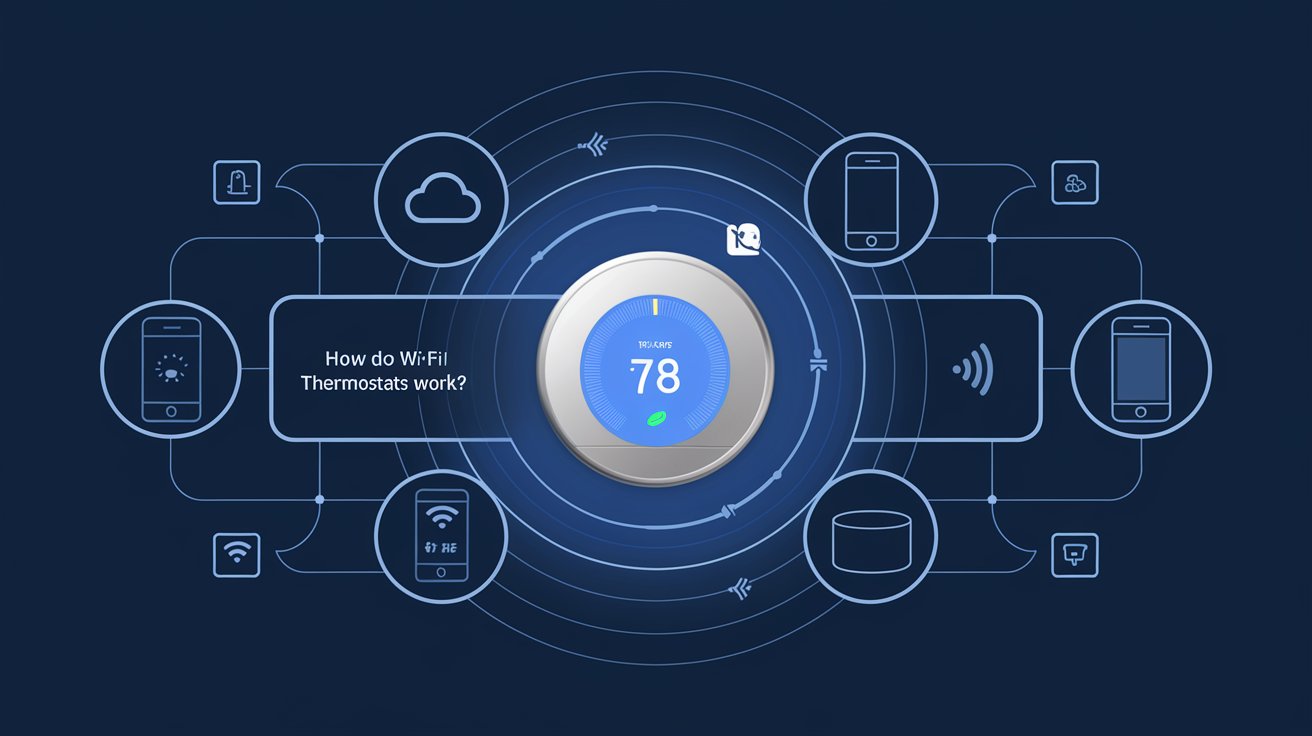
How Do Wi-Fi Thermostats Work?
Have you been curled up on the couch, feeling a little too cold, but the thought of getting up to fix the thermostat seems like way too much effort? That’s where Wi-Fi thermostats come to the rescue!
A Wi-Fi thermostat works just like your regular thermostat, but with a smart upgrade—it connects to your home’s Wi-Fi (just like your phone or laptop). This means you can adjust the temperature right from your phone, no need to get up!
🔥 Why Is That Awesome?
✔ Control your home’s temperature from anywhere—even when you’re not home.
✔ Set schedules so your home is always cozy when you need it.
✔ Use voice commands with Alexa or Google Assistant for hands-free control.
✔ Save money with smart features that learn your habits.
What’s Inside a Wi-Fi Thermostat?
Behind the scenes, it has temperature sensors, Wi-Fi connectivity, and smart technology that help it automatically adjust and keep your home comfortable.
We’re about to dive into how it all works, and get ready to have the inner workings of your Wi-Fi thermostat demystified! Let’s get started!
1. The Core Components of a Wi-Fi Thermostat
A Wi-Fi thermostat is more than just a temperature controller—it’s a smart hub that connects to your home’s wireless network to give you remote control and automation. Let’s break down the key parts that make it work!
🔹 A. The Thermostat Unit Itself
This is the main device mounted on your wall. It includes:
✔ Temperature sensors (like thermistors) that constantly measure room temperature.
✔ A display to show current settings—either a touchscreen or physical buttons.
✔ A Wi-Fi module, which acts like a tiny radio, letting the thermostat connect to your home’s internet.
Without Wi-Fi, it would just be a regular thermostat! The Wi-Fi module operates on specific radio frequencies to communicate over the IEEE 802.11 standard.
🔹 B. Your Home’s Wi-Fi Network
Your Wi-Fi network is the bridge between your thermostat and the internet. It allows:
✔ Remote control via your phone.
✔ Smart home integration with Alexa or Google Assistant.
✔ Automatic updates and energy-saving optimizations.
Different Wi-Fi standards (802.11 b/g/n/ac) affect speed and reliability, but most thermostats work fine on standard home networks.
🔹 C. The Thermostat Manufacturer’s Cloud Server
When you adjust the temperature from your phone, the command doesn’t go straight to the thermostat—it first passes through the manufacturer’s cloud server. This server:
✔ Stores your settings and schedules.
✔ Processes commands from your app.
✔ Ensures security for your data.
Think of it as a middleman that helps your thermostat stay connected and responsive.
🔹 D. The Mobile App (or Web Interface)
Your smartphone app (or web interface) is your remote control for the thermostat. It lets you:
✔ See the current temperature and adjust settings.
✔ Set schedules for heating and cooling.
✔ View energy usage reports to track savings.
When you change a setting, the app sends the command to the cloud, which then updates your thermostat.
✅ Why Does This Matter?
Understanding these components helps you choose the right thermostat, optimize your Wi-Fi setup, and get the most out of smart climate control.
You can also check out more details on Smart Home Ace for a deeper look at thermostat components.
2. The Journey of a Temperature Adjustment: Step-by-Step
A Wi-Fi thermostat does more than just measure temperature—it communicates, learns, and automates to keep your home comfortable. Here’s how it works!
Step 1: Sensing the Temperature
Your thermostat has tiny sensors (like thermistors) that constantly measure the room’s temperature. This real-time data helps the thermostat know when to heat or cool.
Step 2: User Input (Local or Remote)
You can adjust the temperature in two ways:
✔ At the thermostat—Use the touchscreen or buttons to set the temperature manually.
✔ From your phone—Use the app to change the temperature from anywhere.
Step 3: The Data Flow (When Using the App)
When you adjust the temperature remotely, here’s the journey your command takes:
1️⃣ Your app sends the request over Wi-Fi.
2️⃣ . Your router sends it to the internet.
3️⃣ The thermostat manufacturer’s cloud server processes the request.
4️⃣ The server sends the command back through the Internet.
5️⃣ Your router delivers it to your thermostat.
6️⃣ Your thermostat updates the temperature!
This all happens in seconds, making the remote control fast and seamless.
Step 4: Communicating with Your HVAC System
Once the thermostat knows the current temperature and your desired setting, it sends electrical signals to your furnace or AC:
✔ Too cold? → It signals the furnace to turn on.
✔ Too hot? → It signals the AC to start cooling.
Most HVAC systems use relay switches inside the thermostat to open or close circuits, controlling heating and cooling like a digital switch.
Step 5: Learning & Automation (Smart Features)
Some Wi-Fi thermostats learn your habits and adjust automatically:
✔ Predictive scheduling—Learns when you like it warmer or cooler.
✔ Geofencing—Uses your phone’s location to adjust the temperature when you leave or return.
✔ Energy-saving modes—Optimizes heating and cooling to reduce costs.
✅ Why Does This Matter?
A Wi-Fi thermostat makes temperature control effortless, saves energy, and keeps your home comfortable—all while working behind the scenes.
3. Benefits of Wi-Fi Connectivity in Thermostats
A Wi-Fi thermostat does more than just adjust the temperature—it connects to your home’s network, unlocking powerful features that make life easier and more efficient. Here’s why it’s worth the upgrade!
1. Remote Control & Monitoring
✔ Adjust the temperature from anywhere—whether you’re at work or on vacation.
✔ Check your home’s climate in real-time using the mobile app.
✔ Never forget to turn down the heat—control it from your phone anytime.
2. Smart Home Integration
✔ Works with Alexa, Google Assistant, and Apple Siri for voice control.
✔ Syncs with other smart devices, like lights or security systems.
✔ Automates routines—set it to adjust when you wake up or leave home.
3. Energy Savings & Efficiency
✔ Learns your habits to optimize heating and cooling.
✔ Uses geofencing to adjust based on your location.
✔ Accesses weather forecasts to fine-tune temperature settings.
4. Automatic Software Updates
✔ Receives new features and security improvements over time.
✔ No manual updates needed—just approve in the app.
✔ Keeps your thermostat running smoothly with the latest tech.
5. Data Insights & Reporting
✔ Tracks your energy usage to help you save money.
✔ Shows temperature history so you can adjust settings wisely.
✔ Gives personalized recommendations for better efficiency.
✅ Why Does This Matter?
A Wi-Fi thermostat gives you more control, smarter automation, and real energy savings—all from your phone.
Finding Your Ideal Wi-Fi Thermostat
Choosing the right Wi-Fi thermostat isn’t just about smart features—it’s about compatibility, ease of use, and long-term value. Here’s what to consider before making your decision:
1. Compatibility with Your HVAC System
✔ Check your wiring—many smart thermostats require a C-wire for continuous power.
✔ Verify HVAC system support—forced air, heat pumps, radiant heating, etc.
✔ Use Google’s or Ecobee’s compatibility checker before purchasing.
2. Smart Home Integration
✔ Works with Alexa, Google Assistant, or Apple HomeKit?
✔ Syncs with other smart devices—lights, security systems, etc.
✔ Choose a thermostat that fits your existing ecosystem for seamless automation.
3. User Interface & App Experience
✔ Is the app easy to use?—Check reviews and screenshots.
✔ Does it offer customization?—Simple vs. advanced controls.
✔ A confusing app can ruin the experience, so pick one that’s intuitive.
4. Budget & Long-Term Value
✔ Set a budget—Wi-Fi thermostats range from $80 to $300+.
✔ Factor in energy savings—smart scheduling can cut costs over time.
✔ Spending more upfront can mean better efficiency and features.
5. Brand Reputation & Security
✔ Choose a trusted brand—Nest, Ecobee, Honeywell, etc.
✔ Look for regular software updates to keep security strong.
✔ Read customer reviews to check reliability and support.
Before buying, double-check compatibility, compare features, and read user reviews to find the best fit for your home.
Wi-Fi Thermostat FAQ
Q: Do Wi-Fi thermostats need a constant internet connection?
Not always! Your thermostat will still maintain the set temperature even if your Wi-Fi goes down. However, smart features like remote control, voice assistant integration, and learning algorithms require an internet connection to function properly. Without Wi-Fi, you’ll lose the “smart” part of your thermostat.
Q: What happens if my Wi-Fi goes down?
Your thermostat will switch to fallback mode, meaning it will stick to the last set temperature or follow a saved schedule. You won’t be able to control it remotely, but once Wi-Fi is restored, it will reconnect automatically and regain all smart features.
Q: Are Wi-Fi thermostats secure?
Yes, but security depends on the manufacturer and your home network setup. Reputable brands use encryption to protect data between the thermostat, cloud servers, and your phone app. To stay secure:
✔ Use strong passwords for your Wi-Fi network.
✔ Keep your thermostat’s software updated for security patches.
✔ Choose well-known brands with a history of reliable security practices.
Q: Do Wi-Fi thermostats work with all HVAC systems?
Most Wi-Fi thermostats work with common heating and cooling systems (like furnaces, air conditioners, and heat pumps), but compatibility isn’t universal. The biggest factor? The C-wire—many smart thermostats need this wire for continuous power. Some newer models can work without a C-wire, but always check compatibility before buying.
Q: How much data do Wi-Fi thermostats use?
Very little! They only send small bits of data about temperature settings and status updates. It’s nowhere near the amount used by streaming or web browsing, so you don’t need to worry about data usage.
Conclusion: Step into Smarter Comfort with Wi-Fi Thermostats
Wi-Fi thermostats revolutionize home climate control, offering remote access, smart automation, and energy savings. They integrate seamlessly with smart home systems, working with voice assistants and other connected devices.
Here’s why they’re a must-have:
✔ Control temperatures from anywhere—adjust settings remotely.
✔ Save energy with learning algorithms, scheduling, and geofencing.
✔ Stay updated with automatic software enhancements.
✔ Gain insights into your energy usage for smarter decisions.
In today’s modern smart homes, Wi-Fi thermostats aren’t just a luxury—they’re essential for comfort and efficiency. They bridge the gap between traditional HVAC systems and connected living, making climate control effortless.
If you’re ready for a smarter, more convenient, and energy-efficient home, a Wi-Fi thermostat is the perfect upgrade. Welcome to the future of climate control!
Want help picking the best Wi-Fi thermostat for your home? Let’s explore the top models!
You can also check out more details on Smart Home Ace and Easy Tech Solver.